Sunday, September 11, 2011

Ackerman's Repository fabric swatches. for 1809

Ackerman's repository was an English fashion publication that included fabric swatches!
This is very helpfull to us all these years later when we are looking into what fabrics would be good for making our costumes out of.

Be sure to check that they are for garments, not home decorations!
Ackermans Repository January to June 1809 on Archive.org


 January 1809
From Archive.org
No. 1 is a plush (similar to velvet)
No. 2 is a velvet (likely silk)
No. 3 is a brocade or tissue used for pelisses
No. 4 is a floral satin for evening dresses


February 1812
From Archive
 No. 1 is a figgured satin as worn by the Duchess of Chandos at Her Magesty's Birthday
No. 2 is a gold coloured figured satin as worn by Countess Rothsay at Her Magesty's Birthday
No. 3 is a Bishops blue bombazeen, usefull for morning dresses
No. 4 is a silk stripe shawl used for man's waistcoats (vests) and is made of wool and silk.


March 1809
From Archive
No. 1 is Anglo-Merino (wool) cloth, as fine as muslin (the period kind, not what you buy in the stores)
No. 2 is a new article called "queen's silk" and is used for dresses and pelisses, comes in all colors.
No. 3 is a satin twilled silk for dresses and pelisses
No. 4 is a Persian double silk
All three silks are a half ward wide.


April 1809
From LACMA
From Archive
No. 1&2 is a furnishing calico
No. 3 is Scotia silk, manufactured in Scotland. Mixture of cotton and silk, for pelisse and dresses, half yard wide.
No. 4 is a spotted muslin.


May 1809
From Archive
No. 1 is an Adairian dot for morning dresses, yard and a half wide (54")
No. 2 is a white and lilac figured sarsanet for pelisses. half yard wide
No. 3 is a turkish figgured gauze for dresses in a variety of colors, but mainly the one shown, half yard wide
No. 4 is called printed India rib, similar to marcella, used for men's waistcoats.
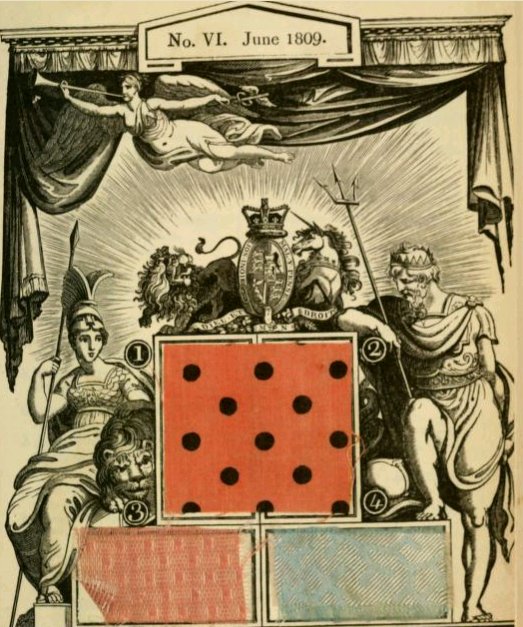


June 1809
From Arcive
No. 1&2 is a cotton for furnishing called Oriental Pink
No. 3 is a lilac spotted gossimer (silk) for full dresses
No. 4 is a white and green coral figgured silk


Ackerman's Repository July to December 1809 on Archive.org

July 1809
From Archive
No. 1 is a yellow printed book muslin for evening dress, an ell wide
No. 2 is a striped mulsin or nainsook, for morning dresses
No. 3 is a printed cambric muslin
No. 4 is a chintz or shawl pattern marcella for men's waistcoats


August 1809
From Archive
No. 1 is Irish net, for dinner and evening dresses, also tippets and scarves
No. 2 is Merico Crape for ladies dresses is a blend of silk and wool, three quarters of a yard wide
No. 3 is Andalusian washing silk used for robes and pelisses
No. 4 is a printed daimond Marcella quilting for men's waistcoats 3/4 yard wide


September 1809
From Archive
No. 1& 2 is a pattern for furniture
No. 3 is an imperial jonquil gause or Spanish net intended for the best robes, worn over white satin or sarsanet
No. 4 is silt striped quilting for waistcoats, best worn with the summer brown or blue coats now in fashion.


October 1809
From Archive
No. 1 is a corded muslin for morning and afternoon dresses, also morning wrap or simple evening frock, as well as children's trowsers
No. 2 is a Brasilian corded sarsanet for robes, pelisses, and spencers, half yard wide
No. 3 is a Pomona green shawl print in imitation of Indian silk, for morning wraps or pelisses. an ell wide
No. 4 is a rose coloured print book muslin for the ball room or evening party. made up as round dresses or French frocks, must be worn over wtite satin, sarsanet, or glazed cambric. an ell wide.


November 1809
From Archive
No. 1 is a fretwork striped muslin for gowns, robes and pelisses, suitable for almost all styles of dress
No. 2 is an arabian jubille silk
No. 3 is an imperial green shawl print, for home costume, morning wraps and high gowns
No. 4 is a chintz kerseymere for mens waistcoats, best suited for the darker winter coats.


December 1809
From Archive
No. 1 is a gold jubilee muslin, good for dinner or evening
No. 2 is a jubilee shawl cambric for the wrap pelisse, round domestic jacket. could be trimmed with black velvet
No. 3 is called gossamere cloth, blended of silk and wool, for robes, mantles, pelisses. The last two should be lined with sarsanet of contrasting colors.
No. 4 is for men's waistcoats

Monday, September 5, 2011

Just a few Bonnet Tutorials

Headware can make or break an outfit. Bonnets were often THE fashion accessory of the day

Here are a few tutorials if you are feeling brave enough to try them.

Twila patterned this bonnet off of one in a recent book. There are 2 more posts on making this cute bonnet. While we are at Twila's blog, check out the Strawberry reticule, for fun!

More tutorials on the net

MLS Designs

The Merry Dressmaker

A member of the Regency Society of America

Izodiea on Livejournal

A member on Burda

Jane Austen Center

Simplicity

Monday, August 15, 2011

Entertainment

Whats a party without Games and Toys?

We must keep the small folks entertained, but honestly the bigguns like to play too!
In my rounds today I discovered Jack Straws or Spillikins, which Jane Austen apparently played. Now as a child I did play with Pick-up-sticks, so I was glad to have another game that we could play.

"One evening, Belinda was playing with little Charles Percival at jack straws."
Belinda, Vol 2, By Maria Edgeworth, 1811, Page 208

"After they had learned these, Harry and Lucy refreshed themselve,s by playing a game at Jack straws, or as some call them spillikins."
Early Leasons, by Maria Edgeworth, 1824, page 249

So I looked for a set. Options were:
1. Antique bone, ivory, wood. Not only would that be expencive, but I wouldn't want to let my children play with them.
2. Vintage plastic or wood. some sets were colored, so that wouldn't work!
3. Historical reproductions. more expencive than the antique if hand carved.

In the end I purchased this vintage set. Hey it was cheap! I figured the off white plastic would "pass" as bone or ivory. If it doesn't meet my standards when I get it, I will look at modern  historical reproductions of wood.

I also have 4 bamboo ball and cup toys from Cost Plus World Market. I am hoping to do paper dolls as well.

I do have a plastic Diabolo, but I don't know how to use it! Wooden ones can be found.

We should look into other toys and games as well.

Monday, August 8, 2011

Food for the eyes

A step away from the costuming for a little bit.
I have 50% secured the location, unfortunatly it is going through a remodel and I don't know exactly how it will look when finished! I have heard 2 things require more thought.
1. No tape or holes are to be put on/in the walls.
2. There will be exercise equipment folded against the walls. I don't know what type though.

There are 2 bathrooms and a number of folding tables and chairs as well as a full sized, though small kitchen and a fireplace. Maybe some of that exercise equipment can be pushed into one of the bathrooms or under a table? Don't know will wait and see.

So we have decorating issues to deal with and quite a bit of unknown.
I have thought of purchasing a large white sheet and painting a backdrop for a "photo session" location, which of course means I will have to brush up on my faux painting. I have been looking through regency era copper plates published in magazines of the era to get an idea of decorations. Looks like we will need some cheap fabric for curtains! We will also need table cloths. Now I do not know what to do about the chairs. the period chairs I am finding look very different from our modern folding chairs. I do how ever have a half dozen or so wooden folding chairs, and we could make fabric slip covers?

I have begun collecting electric candles, so far I have a dozen pillars, I still want some tapers and I know my guests are looking for lights as well.

The other thing I have bugun thinking about is food.
I have decided against attempting a period dinner for several reasons
1. I am not a good cook, I am also a picky eater. I also do not want to spend time on researching and learning recipies. I also do not want to put more pressure and resposibilities on my guests than is needed. I know some of them are likely to stand up and offer to help, but I think attempting to be historically accurate on food is a waste of our time.
2. I know my guests have certain dietary issues, including but not limited to: Kosher, Diabetese, Gluten sensitivity/allergy, Lactose sensitivity/allergy. We also will have 7 children under the age of 6!

I have found that a local bakery will make Gluten Free cakes, some of which are also dairy free. I have not been able to try them yet, as they are not a regular offering. Maybe I should order some cupcakes for my husband's birthday as a test?

There will be NO alcohol at my party. There will however be a little keg of root beer, plus some other sparkling juices to make a festive appearance in our glasses! If you have a favorite sparkling juice/ carbonated beverage, please let me know!

Then there is the issue of what to eat off of? I refuse to use plastic plates that are meant to be tossed in the garbage, I also can not compost. I only have enough plates to serve about 6 people, my mismatched silver-wear can do about 10, I have a set of 6 spoons for little people. So I am looking at nice reusable or recyclable dinner, flat, and beverage wear. I would like to avoid all colored plastics. I am thinking of things that truly mimic glass, crystal, and ceramic. My best bet might be to get some more silver-wear for my home, plus some forks for the kidlets.

This morning, we had pancakes and I used the last of the maple syrup, I was looking at the bottle and noticed just how much it looks like ancient pottery, but in plastic! so I am saving the bottle to be used as a decoration, the threads will be cut off. The Regency/Empire/Napoleonic period was positively saturated with influences from the ancient Greeks and Romans, so keep your eye out for inspiration!

Friday, July 29, 2011

Girls dress patern inspiration

Today I spent some time pulling together some images of Printed Cotton Children's Regency Era Dresses.
I had to use originals as my inspiration as the majority of Fashion Plates and Paintings show white, sometimes solid color dresses.

So Here are the inspiration dresses so I can start drafting a pattern

The first pink original found on ebay on Jessamyn's Regency Costume Companion article on Children's Clothes

Next comes a boy's dress from Massillon Museum, Massillon, OH, which was included in Kent State Univeristy Museum's 2006 exhibit Fashion on the Ohio Frontier a better view can be seen on Maggie May Fashions
Tidens Toj shared the pattern for their child's dress.

Then there is this lovely roller print one found on I-like-historical-clothing, which seems to have sold on Vintage Textile

Wisconsin Historical Sociey has another long sleeve dress with buttons on the upper cuff.

Vintage Textile has this lovely dress with long sleeves under the short puffs.

Last is this pink one, for which I have the reproduction fabric from the Lady's Repository Museum

I also have a few saved from e-bay to inspire me.

So far the plan is this: short sleeves with longer lowers that can be buttoned on (or permanently attached if so desired) the back will have ties or a button band. I am wanting a gathered front, but maybe the flat front would be a nice change to see?

Thursday, June 30, 2011

Regency Shift/Chemise pattern

“ladies used to wear shifts; they now are called chemises: shoes are turned into sandals, stays are corsets, a girdle is a zone, a band for the head is a diadem, a gown is a robe,” quote by Althea Fanshawe  in 1806

 Well I made my pattern and I made a mock up and now it is ready to share with you!
First off this is not a pattern fro the Historical Accuracy snobs. If you want complete historical accuracy, go buy a pattern from one of the well known pattern companies.

This pattern is one that I personally developed based heavily off of Museum of Fine Arts Boston 99.664.51 and by looking at the instructions in The Ladies Economical Assistant (1808) by Kannik's Korner and The Workwoman's Guide (1838-40) and many other shifts and period diagrams for shifts.


This pattern is multi-sized, but has not been tested for all sizes. Read more bellow

Tuesday, June 28, 2011

Regency Shifts and Chemises

I am developing a pattern for shifts/chesmises for the ladies to wear under their regency gowns. So today I poked around at museums to find some examples.

Museum of Fine Arts Boston 99.664.51
MFA 99.664.26
MFA 49.895
MFA 49.897
MFA 49.900

Met C.I.41.161.7
Met 1999.216.1
Met 2009.300.392